

Shipping faster is only half the equation. We believe the real competitive advantage belongs to teams that treat go-to-market as a product problem and build the organizational motion to match.
AI coding co-pilots have compressed product development cycles in ways that weren’t possible a few years ago. Product teams are shipping more, faster. That’s genuinely exciting for any company serious about innovation.
But speed creates a new kind of pressure. As product velocity increases, go-to-market (GTM) motions built for a slower cadence can struggle to keep pace. The opportunity in front of B2B software companies right now is to close that gap intentionally by applying the same architectural thinking that transformed product development to the product launch motion itself.
Understanding the Structural Challenge
Both product development and GTM launches were historically built as linear, sequential processes, and for good reason. Sequential handoffs offered predictability and clear accountability at each stage. Product moves through requirements, design, code, test, review, deploy. GTM moves through brief, research, positioning, messaging, asset creation, review, launch. Like the Roman aqueducts, these systems were a genuine engineering achievement for their era: effective, reliable, and impressive at scale.
The challenge isn’t that these processes were poorly designed. It’s that the pace of innovation has changed faster than the processes have. Three dynamics now create friction in the linear model:
- Speed divergence: Product can now iterate faster than GTM can sequence through its launch stages. When product velocity accelerates, as it has with AI-assisted development, the gap between what’s been built and what’s been communicated to market naturally widens. This is a design challenge, not a performance issue.
- Context in transit: Each handoff in a sequential process is a place where nuance can be compressed. The customer insight a PM carries, the specific buyer pain, the moment of friction, the language that resonates, is a rich signal. Structuring the process so that signal travels intact all the way to market-facing execution is the real design challenge.
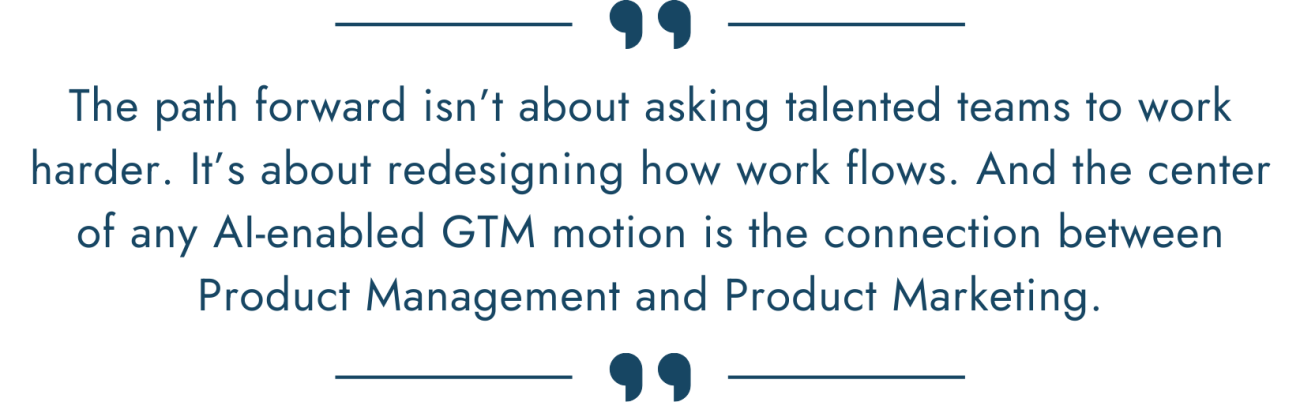
- Architecture as the lever: Because these are structural dynamics, structural solutions are what work. This is encouraging: it means the path forward isn’t about asking talented teams to work harder. It’s about redesigning how work flows.
The New World: Apply the Tight Loop to GTM
Product teams have led the way here. The evolution from a waterfall development lifecycle to iterative, AI-supported development, where AI handles execution and synthesis while humans own intent and judgment, has transformed what’s possible in product cycles. That same architectural logic translates directly to the go-to-market motion.
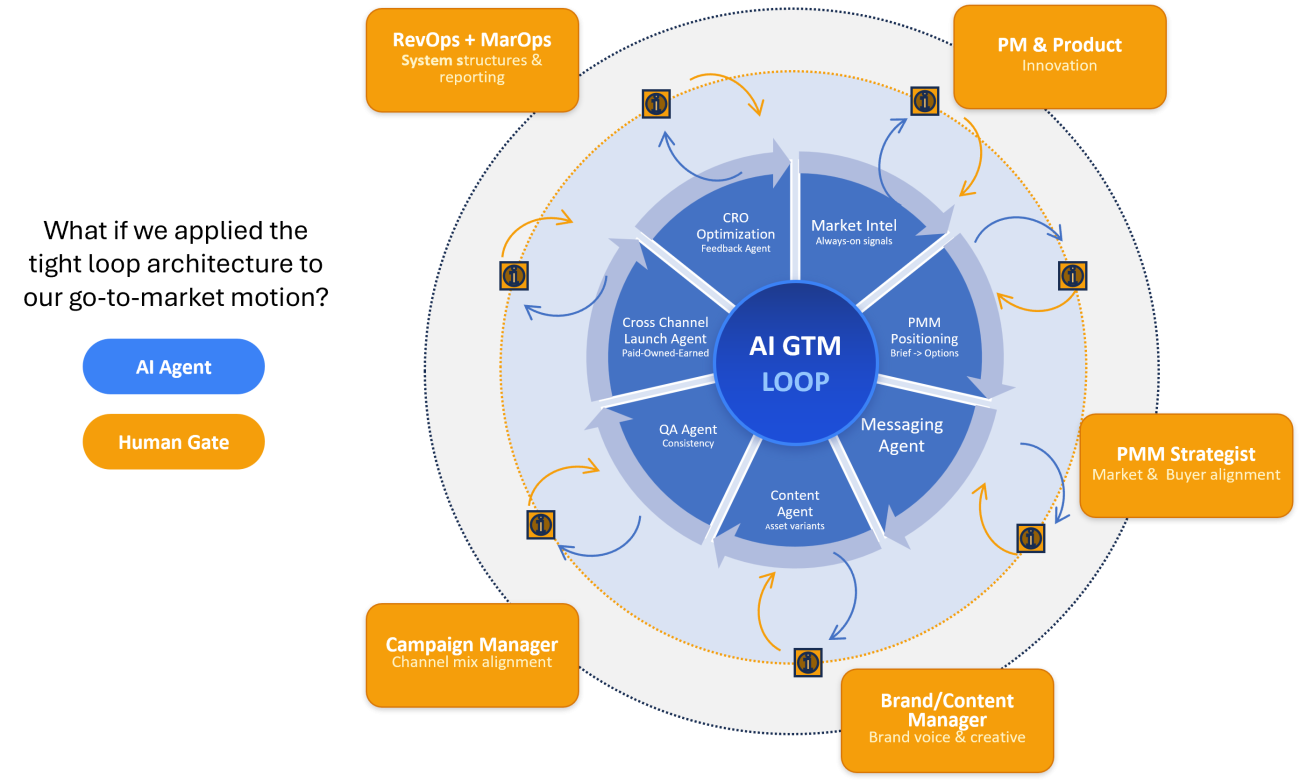
Rather than a linear launch sequence, the AI-enabled GTM loop runs continuously: always-on market intelligence feeds a positioning agent, which informs a messaging agent, which generates content variants for a QA agent, which deploys across channels and feeds performance signals back into the next iteration. Human judgment gates are built into the loop at specific points, not as approval stages, but as genuine checkpoints where strategic context is validated and drift is caught early.
Change Management Is the Real Work
The tools to build an AI-enabled GTM loop exist today. What separates teams that make it work from those that don’t isn’t technology. It’s the organizational change management required to adopt it durably. Introducing AI-enabled workflows is as much a leadership and culture challenge as a process challenge, and the companies that get ahead of it intentionally tend to move faster and sustain their gains.
Here’s what that change management work looks like in practice:
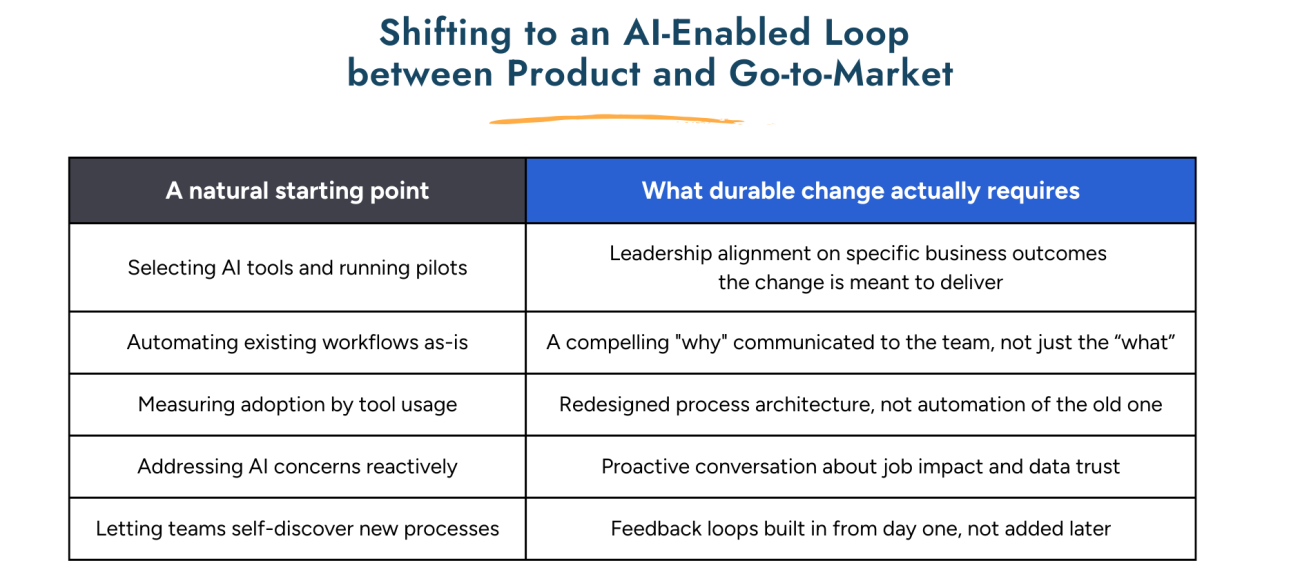
To introduce this change, pilot it with high-impact use cases rather than low-stakes experiments that don’t surface the real questions. Equip teams with practical training, not theoretical overviews of what AI can do. Update performance metrics to reflect the new motion and celebrate early wins. The organizations that get this right treat AI as a reason to rethink how work gets done, and they bring their teams through that rethinking with intention.
The PM–PMM Relationship Is Your Biggest Leverage Point
At the center of any AI-enabled GTM motion is the relationship between Product Managers (PM) and Product Marketing Managers (PMMs). It’s the connective tissue between what you’re building and how the market understands it. Strengthening that connection grows more valuable as product velocity increases.
The upstream opportunity: when PMMs receive not just a Product Requirements Document (PRD, the spec written to align engineering) and a launch date, but also the customer development work behind the feature, positioning can become far more precise. That work includes the specific conversations, the personas, and the moments of friction that drove the build in the first place. As the custodian of the customer voice before launch, the PM making that voice accessible earlier and more completely is one of the highest-leverage structural changes a team can make.
The downstream opportunity is equally significant. Today, PMM tracks campaign metrics, PM tracks product usage, Sales tracks deal outcomes, and RevOps tracks revenue, often in separate systems with no shared view. Building even a lightweight connection between these signals creates a feedback loop that improves positioning, informs the next product cycle, and helps identify where message and market are actually aligned. That shared signal is what makes the GTM loop self-improving over time.
Customer Voice Is a Living Signal, Not a Launch Input
The best positioning doesn’t come from a brief written in isolation. It usually comes from how customers talk about the problems your product solves, in their own language, after experiencing it. Treating customer voice as an ongoing signal rather than a discovery phase is one of the most practical ways to improve the quality of what flows into your GTM loop.
Three signals that are often already available and can be systematically incorporated:
- Post-launch usage language: How customers describe the feature in support tickets and community forums after using it. This is often better positioning than anything written from scratch, and meaningfully different from what you heard in discovery.
- Sales call signal: The moments in recorded calls where a prospect leans in or goes quiet when a feature is mentioned. A PM with AI agent assist reviewing these calls will surface the exact language that lands, faster than any research project.
- Churn and expansion language: Why customers with the feature renewed or expanded, in their own words. This is as close as you’ll get to the buyer’s actual internal ROI argument, and it’s rarely fed back into positioning.
Feed all three into the PM–PMM brief before the positioning agent runs. The quality of the loop’s output is a direct function of the quality of its inputs: rich signal in, precise positioning out.
Where to Start This Week
Building an AI-enabled GTM motion is not a long-horizon transformation project. There are three concrete steps your team can take in the next five business days that create immediate clarity and momentum:
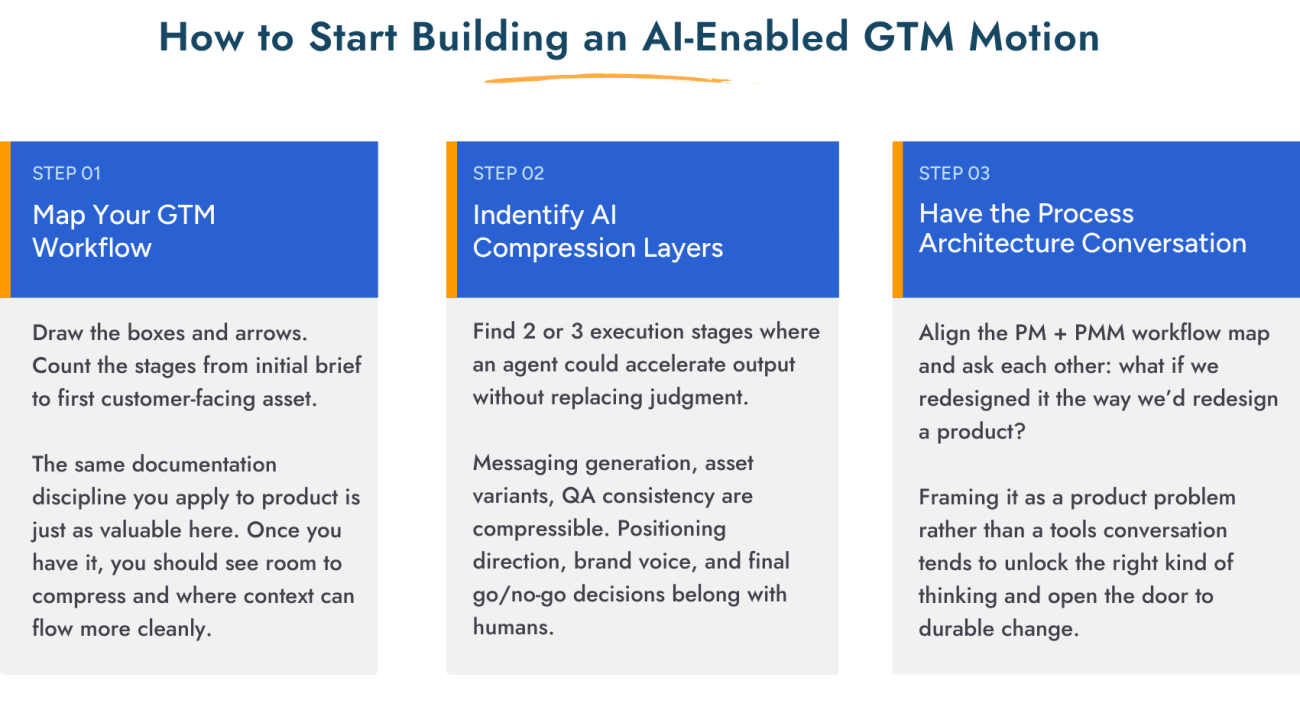
- Map your GTM workflow. Draw the boxes and arrows. Count the stages from initial brief to first customer-facing asset. The same documentation discipline you apply to your product process is just as valuable here, and once you have it, you’ll immediately see where there’s room to compress and where context can flow more cleanly.
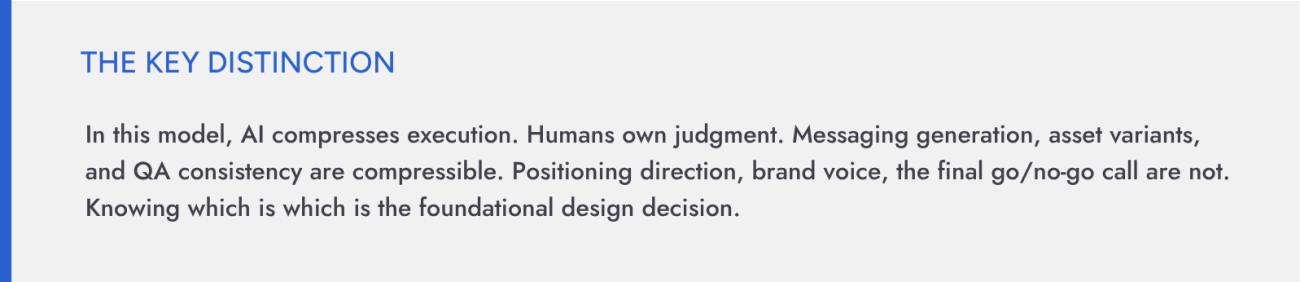
- Identify your AI compression layers. Find two or three execution stages where an agent could accelerate output without replacing judgment. Messaging generation, asset variants, QA consistency are compressible. Positioning direction, brand voice, and final go/no-go decisions belong with humans. Mapping which is which is the foundational design decision.
- Have the process architecture conversation. Align the PM + PMM workflow map and ask each other: what if we redesigned this motion the way we’d redesign a product? Framing it as a product problem rather than a tools conversation tends to unlock the right kind of thinking. That’s the conversation that opens the door to durable change.
The Teams That Win Won’t Just Have Better Features
The teams that win the next wave of AI product launches won’t simply be the ones who built the best features. We believe they’ll be the ones who treated GTM as a product problem and built an AI-enabled launch motion that is as fast, as iterative, and as learnable as the product itself.
That is the work in front of all of us right now.
