

AI does not lower the bar for technical leadership. It raises it, setting unprecedented pressure on deciding where to sprint, when to pause, and how to avoid AI bets that compound risk instead of value.
The need to move fast on AI is real — and justified. But we have heard this story before, and the ending is not what most people expect.
When 4GL tools like Access and Excel put development power in the hands of business users, the prediction was simple: software gets easier, you need fewer technical experts, speed wins. The opposite happened. Cheaper building created more demand, not less. Application sprawl exploded. And the companies that moved fast without governance or architectural clarity spent years untangling fragile spreadsheet ecosystems that had quietly become mission-critical infrastructure.
AI feels like that moment at 10x the scale.

The Real Differentiator Isn’t Speed
With AI, the tools are more powerful. The leverage is higher. And the cost of bad decisions compounds faster. Complexity does not disappear at inflection points like this — it migrates up the stack into architecture, data strategy, and capital allocation.
So how do you win? Every company has access to the same models, so speed alone is unlikely to be a differentiator. We believe the differentiator is judgment at velocity: the ability to think clearly where to sprint, when to pause, and how to avoid AI bets that compound risk instead of value.
If you are running a software company and your board and the market are telling you to go fast on AI, that instinct is right — but only half the directive. The full message should be: think clearly, then go fast.
Here are three questions to ask yourself and your team right now to level set if you have clear direction, capital discipline, and a sense for the impact if your AI bets are wrong.
Question 1: Are we building toward a clear architectural vision?
AI amplifies every decision, good and bad. Before your team moves fast, they need alignment on what the system looks like when AI agents are first-class participants. Without that vision, speed is just a faster way to accumulate technical debt.
This is the question most founders skip because it feels like it slows things down. It does not. Rather, it prevents the kind of rework that actually slows things down: quarters of refactoring because nobody agreed on where the AI layer sits, how data flows through it, or what the system looks like at scale.
You do not need to have every answer. But you do need your team aligned on a direction before they start building.

Question 2: Is this a problem AI should solve, or a problem AI can solve?
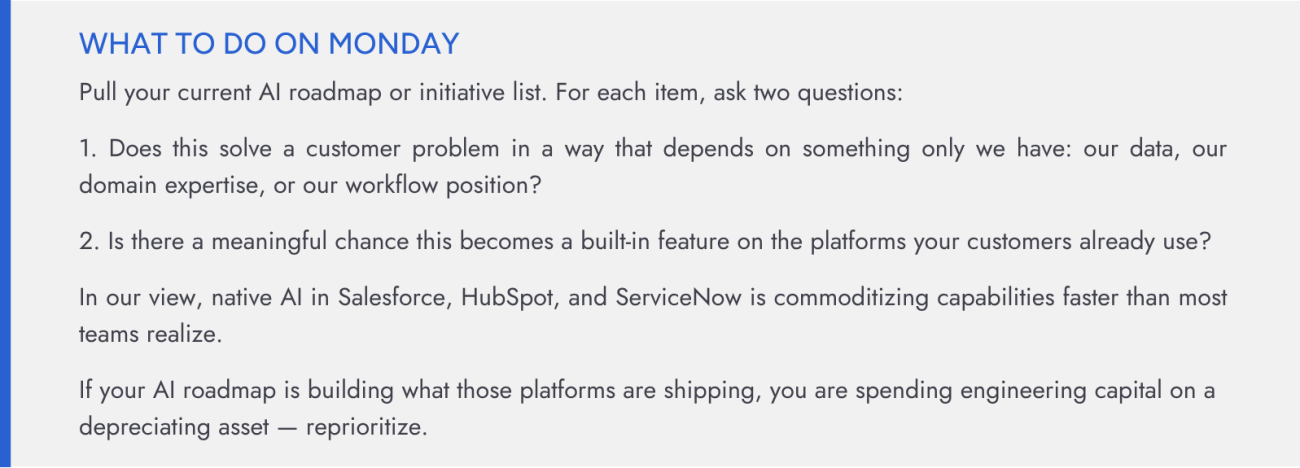
The tools can do a lot. That does not mean they should. One of the most dangerous patterns right now is teams building AI features because they can, not because AI is the right tool for the job to deliver customer value. The result is features that are technically impressive and strategically irrelevant — or worse, features that become a commodity baked into the platforms your customers already use.
For a founder, this is a capital allocation question. Every AI initiative your team pursues has an opportunity cost. The judgment to distinguish between ‘we could use AI here’ and ‘AI is the right tool here and it reinforces our competitive position’ is one of the most valuable skills your leadership team can develop right now.
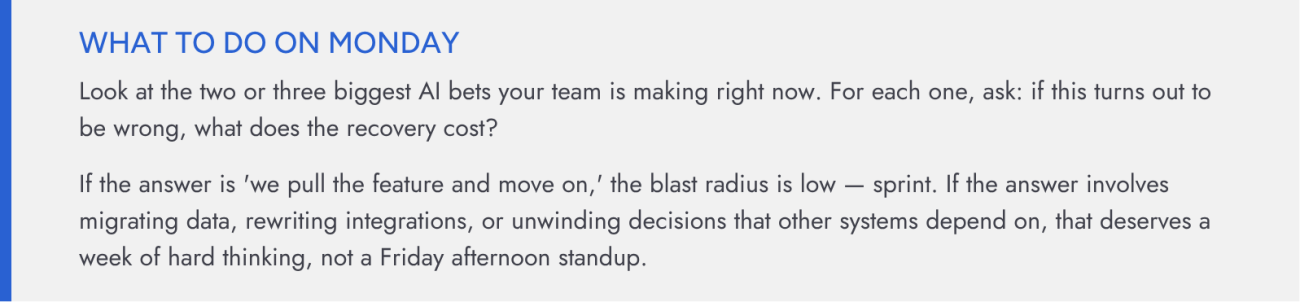
Question 3: What does the blast radius look like if we are wrong?
There is a myth worth addressing directly: fast iteration does not make reversibility free.
For features, the cost is user trust. Every feature you ship that misses the mark spends a little of your customer’s attention and goodwill. In our experience, features cost 10x what some teams estimate when you account for the full lifecycle: design, development, testing, documentation, support, and the ongoing drag of added complexity without proportional added value. Shipping and walking it back is not iteration — it’s rework with extra steps.
For architecture, reversibility is even more expensive. You cannot A/B test your way out of a bad foundational decision. By the time you know it was wrong, it is load-bearing. The blast radius of a poor architectural call made at AI speed is not a sprint’s worth of rework. It is quarters.
For data strategy, the blast radius is hardest to see until it is too late. Your proprietary data, your domain-specific training sets, your unique position in the customer workflow — these are often the only durable moats in an AI-native market. If you train on generic data, partner too loosely, or fail to lock down contractual rights to the data your product generates, you hand your differentiation to the next company that will not make the same mistake. Treat your data position like the strategic asset it is — not an afterthought behind the feature roadmap.
The discipline is not think instead of sprint. It is vet, then commit, then move fast.
Point the Machine in the Right Direction
Every time the abstraction layer rises, the assumption is that the job gets easier. It does not. It gets more leveraged. The floor goes up, the ceiling goes up, and so does everything in between — including the cost of skipping the thinking.
John Henry’s mistake was not that he was strong. It was that he tried to outwork the machine instead of leveraging it. We believe the founders who win in this era will not be the ones who shipped fastest. They will be the ones who thought clearly while everyone else was sprinting, pointed the machine in the right direction to deliver customer value, and built things that compounded instead of collapsed.
The question is not how fast can we go. It is how clearly can we think while we do.

