

This is part of Mainsail’s How-to-Hire Series: A Founder’s Guide to Building Out Your Leadership Team. Read why we put together this resource for growing software businesses and how to navigate it here.
In the first post of this series, we covered the key signals that it’s time for a B2B software founder to hire their first finance lead, along with the qualifications and characteristics to look for, drawn from our experience hiring CFOs across many Mainsail portfolio companies.
But knowing who to hire and knowing how to interview for it are two different things. If you’ve never hired a CFO before, it’s hard to know which questions will help separate good candidates from great ones. In this post, we’ll walk through five questions and conversations to use in your interviews to benchmark candidates against those qualifications and then how to set your new CFO up for success in their first nine months.
Evaluating CFO candidates in the interview process
Before you start interviewing, define what you want in this hire.
Do you want a proven CFO who is experienced but may be set in their ways, or a hungry “up-and-comer” more open to adapting? Do you want someone who has worked in your vertical or with your go-to-market motion, or a “good athlete” who can learn your market and business? To refine your answer, talk to fellow entrepreneurs about what worked for them.
Here are some conversations to have with candidates that can help tease out helpful insights:
“Describe the last business(es) you worked in.” If they only talk about numbers, that may indicate they didn’t really understand the business — or worse, they didn’t care.
“Describe your process for building a new logo bookings budget. What specifically did you do versus what did you rely on others for?” Look for candidates who get into the weeds on KPIs, data analysis, and testing inputs and outputs. If you don’t hear a lot of detail or enthusiasm, it may indicate the candidate doesn’t want to roll up their sleeves.
“What did you do in college for extracurriculars?” This gives you a read on their competitive drive, affinity for teamwork, ability to manage time, and the ways in which they process information.
“What was the worst conversation you ever had with a boss?” Their answer will show how they argue, compromise and/or hold firm. You’ll also gain insight into their EQ and ego.
“Walk me through a specific example where you used an AI tool to improve a finance process or analysis. What was the tool, what did you do, and what was the outcome?” Look for candidates who can cite a concrete, recent example rather than speaking in generalities. Strong candidates will describe not just what the tool did, but how they verified the output, what they learned, and how they applied it. Candidates who struggle to give a specific example may be overstating their AI fluency.
Framework for enabling success in the first nine months
Setting expectations for your new CFO should be a two-way dialogue. Define expectations during the interview process; formalize it after the hire; then check in regularly. I recommend a 3- 6- 9-month check-in cadence.
The first thing your CFO should do is gain a deep understanding of the business. They should work with the management team to understand your product, market, customer base, and competitive landscape as well as the drivers of success for each internal function. What makes it successful? Where are the challenges? Who are the customers and what is the product usage and pricing model? What are the pain points, renewal rates, upsell opportunities, retention rates, etc.? What are the opportunities and threats?
They should also evaluate your finance team and form a view of the existing talent and potential gaps. Then develop a plan for upleveling and expanding the team as budget permits.
There will be plenty of requisite blocking and tackling in the early days. They will need to set priorities for a range of core activities such as establishing a sound data infrastructure, enhancing KPI reporting and developing a reporting cadence, converting from cash to GAAP accounting, building a budget, performing budget vs. actual variance analysis, supporting you in the strategic planning process, and implementing long-term financial planning.
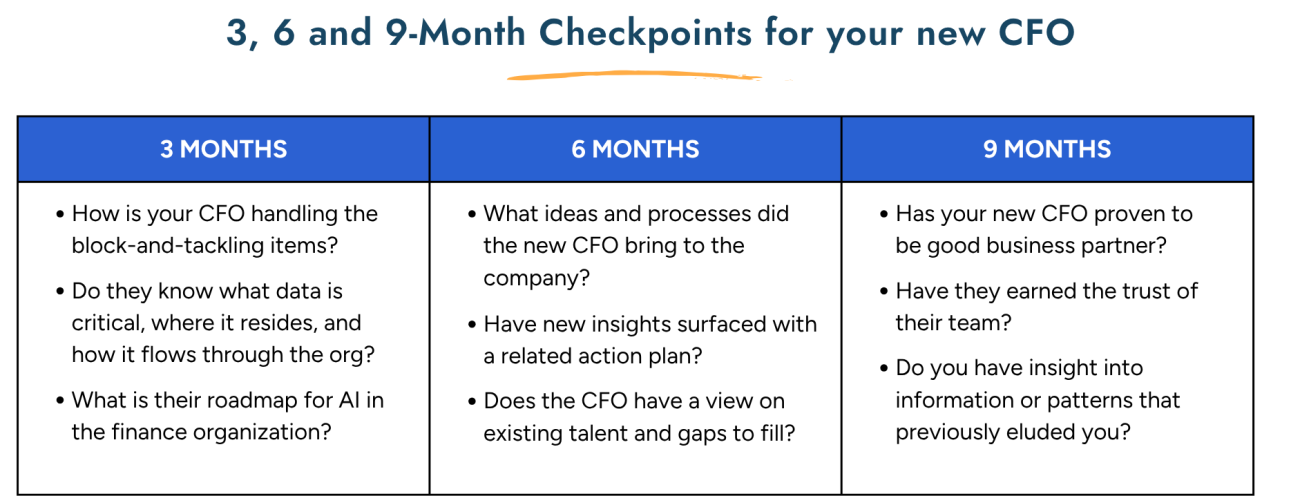
Within 90 days, a new CFO hire should understand what data is critical to operating and evaluating the business, where it resides, the “source of truth” for various elements of data, and whether it flows consistently throughout the organization. They should understand where AI is being used for data analysis and reporting and have developed a roadmap for enhancing use of AI throughout the finance organization. That roadmap should identify the highest-value AI use cases for the finance function — such as automated reporting and close checklists, AI-assisted forecasting and scenario analysis, and natural language querying of financial data — and prioritize them by impact and feasibility. It should also address any governance considerations. They should have gotten to know their team and formed a view on whether they have the right people in the right roles.
Alongside these operational efforts, CFOs need to build relationships with their peers on the management team. They should get to know the investors and the board. Across all connections, they need to build trust and effective communication.
At the three-month check-in, evaluate the blocking-and-tackling items, the processes they’ve built, and the relationships they are developing. Identify what new ideas, processes or ways of thinking they have brought to the business. By six months, you should start to see your new hire surfacing insights. By nine months, you will know whether they are going to be a good business partner.
Trust and evaluation of fit take time to evolve, so consider these timeframes as guidelines, not hard deadlines.
Why this hire is worth the wait
Many founders put off hiring finance leaders because they default to performing financial tasks themselves and hire in other functions instead. In many cases, they are able to justify punting because they don’t really appreciate the value they and the business can accrue from an experienced financial partner.
However, once they start interviewing real candidates, the difference becomes clear, and the blinders come off regarding the impact this hire could have on the business. Once the CFO is in the seat, founders see how this right-hand person can move the business forward with insight and operational efficiency and wonder how they got along for so long without them.
As you approach your first finance leader hire, aim high and remain open-minded as to how much they could move the needle.
