

This is part of Mainsail’s How-to-Hire Series: A Founder’s Guide to Building Out Your Leadership Team. Read why we put together this resource for growing software businesses and how to navigate it here.
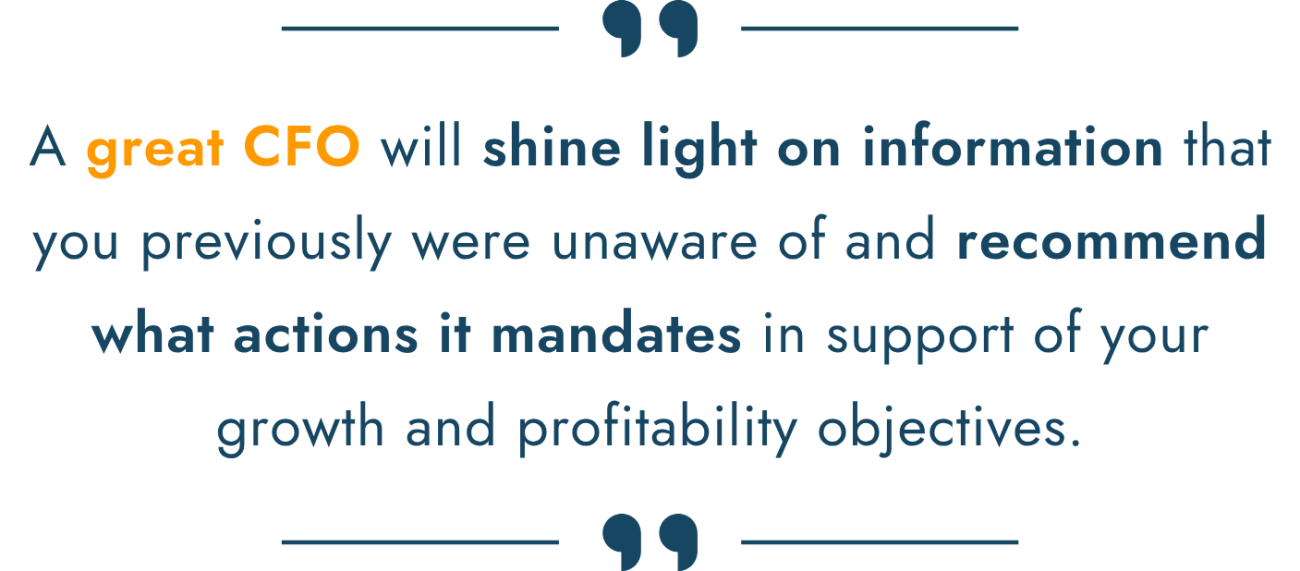
In the early days of a company, most founder/CEOs opt to manage their company’s finances themselves. Over time, however, a CFO will become one of your most important hires and a trusted business partner. A good CFO will shine light on information that you previously were unaware of, and a great CFO will recommend what actions that information mandates in support of your growth and profitability objectives.
Of course, that all takes time and hinges on hiring the right CFO for your business.
In this post, we will review the key indicators it’s time to hire a finance lead, the qualifications and characteristics to look for in this person, and some barometers by which to measure their success.
When to hire a CFO
The biggest indicator you are ready to hire a CFO is that you (the founder) are spending too much time on the financials and not enough time on product, go-to-market, customer retention and other high-value activities. Alternatively, as your business evolves, you may find that the financial implications of growth have surpassed your skills or understanding, or you are surprised by your business results as compared to the expectations (in either a positive or negative way).
Some additional hiring triggers for a CFO include:
- You are contemplating an add-on acquisition
- You are thinking about adding an ancillary revenue stream
- The business is moving into a new market
- You’re considering geographic expansion
In these cases, financial management of your business, and the amount and types of data you will need to analyze, are about to become more complex. You will benefit from having a finance leader before that happens.
Keep in mind that the specifics of this role will evolve based on your company’s needs and maturity. We find that many first-time entrepreneurs hire a CFO to help with bookkeeping and accounting needs while seasoned CEOs prioritize operational imperatives such as data infrastructure, KPI reporting, financial planning and budgeting.
Aim high and hire a finance leader who can help you scale the business operationally well beyond where it is today.
Qualifications to look for in a CFO
→ Your CFO must be able to organize and analyze data across the business and produce accurate and insightful reporting. To do so requires an understanding of people, processes, and systems both within and outside of traditional financial functions.
In the best-run software businesses I’ve seen, the CFO oversees Revenue Operations — the set of people, processes and systems that collect, organize, and flow data throughout business functions from lead-to-cash and thereafter to renewals, upsells, and cross-sells. While not expected to be a computer scientist, a CFO must understand how these systems process and hand off data so they can influence their design and implementation.
→ Your CFO should also be comfortable using AI tools, understand the financial and operational impact that these tools can have, and be a supporter of proliferating these tools throughout your organization. In practice, this means they should have hands-on experience applying AI to core finance functions — for example, using AI-assisted tools to accelerate financial close and reporting, automate variance analysis and commentary, enhance the speed and accuracy of scenario planning and forecasting, and flag anomalies in revenue or expense trends.
→ Your CFO should have scaled a business well beyond your current size and ideally beyond the size implied by your long-term financial plan. They should be experienced with capital allocation decision-making and have been through a successful exit process for a high-performing SaaS business.
→ In terms of hard skills, your CFO should have strong spreadsheet skills and be comfortable with complex data and the systems and processes for managing it, including cutting-edge AI tools. They should have a thorough understanding of SaaS KPIs and be strong in long-term financial planning, building a bottoms-up budget, and maintaining a rolling forecast.
On their CVs, prioritize experience with budgeting, financial modeling, data organization, and KPI reporting. Some backgrounds we find promising include having been an investment banking analyst (where they learned hard-core financial modeling) or having had an FP&A role in a large and well-respected business to learn best practices. Having an accounting background can be useful, but usually only if the candidate has migrated to finance and had several successful reps in FP&A or VP of Finance roles since that transition.
Ideally, the candidate will also have experience working constructively across functions in a SaaS business, even at a junior level. They should be fluent in the operations of all key functions — especially sales, marketing, and engineering — and able to translate KPI reports into action plans across functions.
→ If you are contemplating add-on acquisitions, your ideal candidate will have experience with conducting financial due diligence on an M&A target and know how to build a merger model. The candidate will also have played a meaningful role in an equity or debt capital-raising process for a high-performing SaaS business.
→ Finally, your first financial leader needs to be able to roll up their sleeves, get into the data, and perform the FP&A function themselves. Many experienced CFOs will hire a Controller to manage accounting but, for at least the first year or two, your CFO needs to build and own the financial model and annual budget so they can learn in detail how the business operates.
Characteristics to look for in a CFO
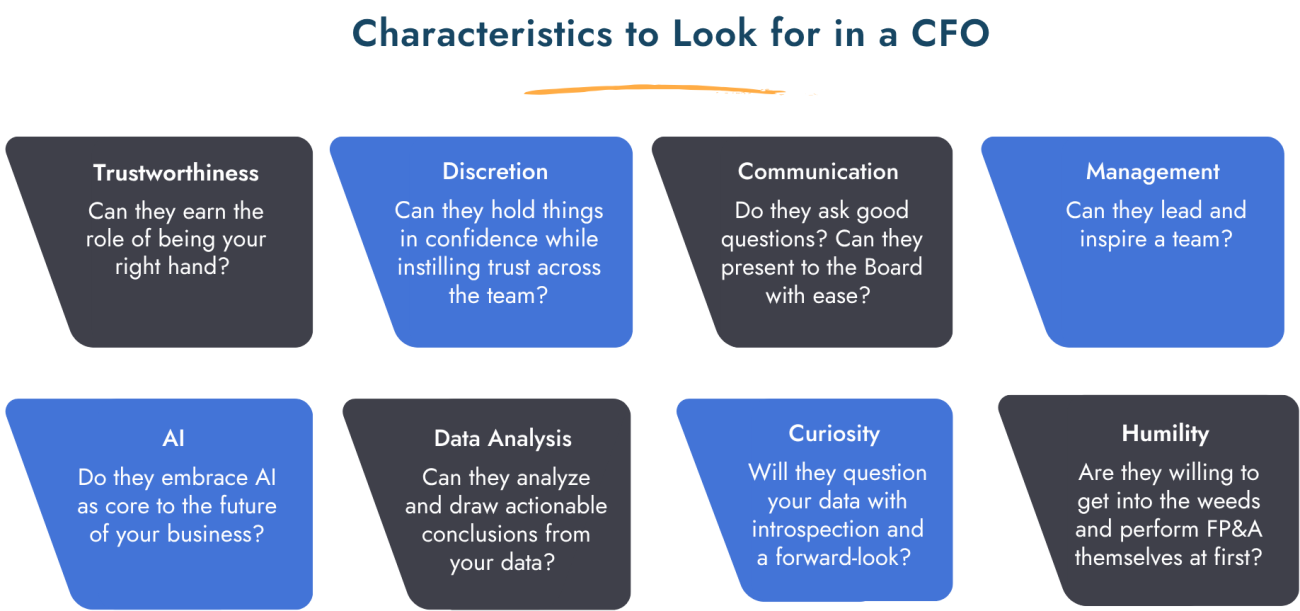
Prioritize trustworthiness by looking for discretion. Because your CFO has access to more information than their peers on the management team, selecting a partner with discretion is paramount. Not only do they need to keep things confidential, they also need to do so in a way that doesn’t create distrust among colleagues. Similarly, they should be capable of serving as an initial sounding board for your ideas and a source of feedback on financial tradeoffs and implications.
Your CFO should be an excellent communicator, capable of asking questions and having difficult conversations across functions and especially with you. Confident enough to challenge you (backed by data) but mature enough to do so constructively. You should also feel confident that they can present financial information to your board and answer challenging questions credibly.
Your CFO should be a good manager, as they will manage core financial functions and potentially others where they do not have first-hand domain knowledge (e.g., Legal, HR and IT).
A successful CFO will also be highly curious. You don’t want a “yes man;” you want someone who can form conclusions and a proposed action plan based on what they observe. They must be able to look backwards, forwards, and around corners. They should be your right-hand person in running an annual strategic planning session and translating the outputs into a long-term financial plan and budget.
Lastly, your CFO should have a growth mindset, eager to learn new skills. In particular, your CFO should be an enthusiastic and experienced user of AI tools, an advocate for expanding AI usage across the business, and a role model to their team and others in learning and improving their AI skills.
Now that you have a sense for what to look for in hiring your first CFO, read (Part II) on how to interview CFO candidates and set them up for success in the first nine months.
