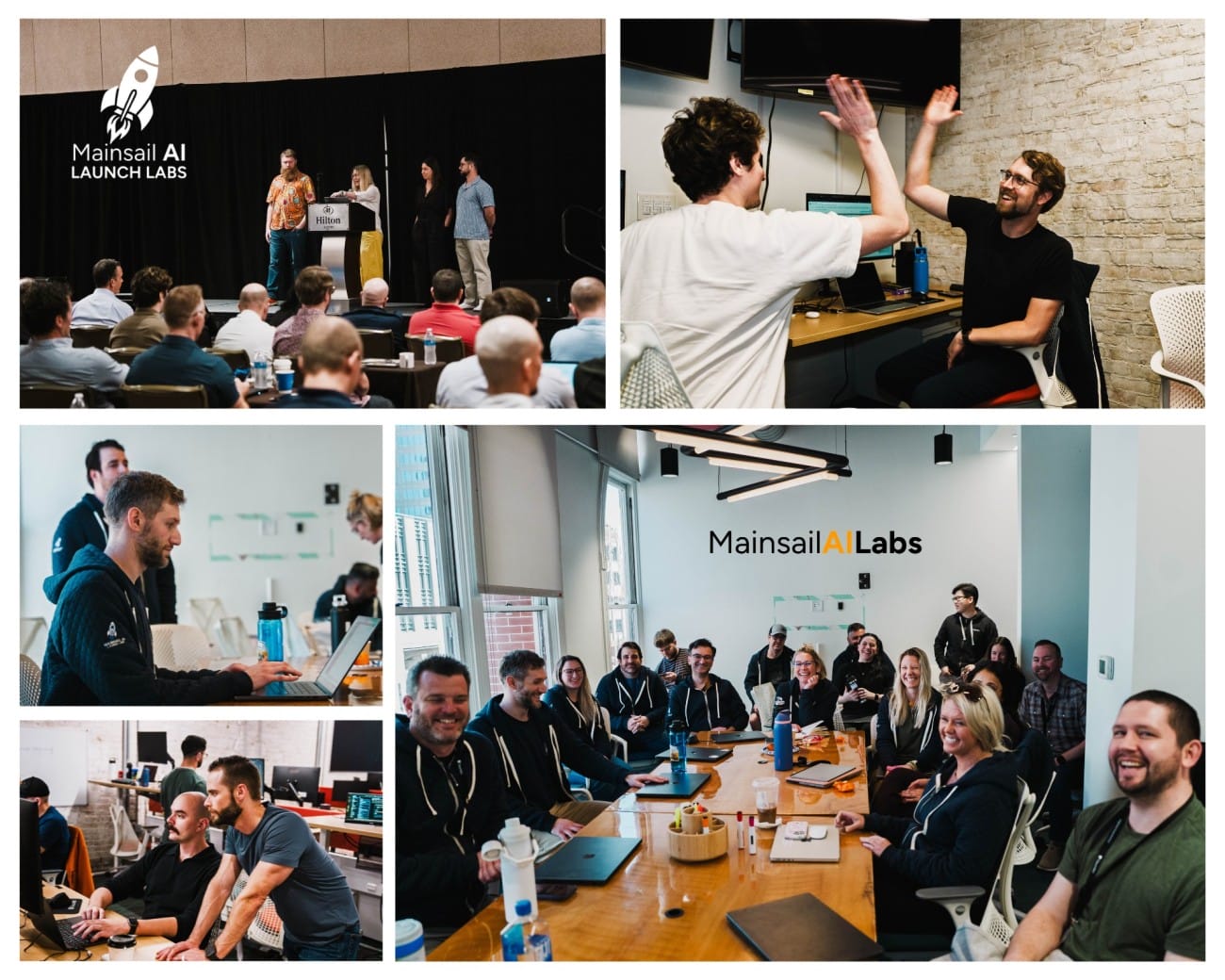

If you’re a founder trying to figure out how to operationalize AI in your business, the pattern recognition we’ve built over the past year through Mainsail AI Labs has taught us some lessons to pass on.
A year ago, we were learning what AI could do, what our portfolio teams were capable of, and how to build for both scale and customer value. Twelve months later, many of our companies have operationalized real agents, and genuinely transformed how they operate. You can see a dozen examples here of what they launched (or acquired) to help solve customer problems and start to reshape their industries.
The work has been impressive. And the perspective we’ve built across those experiences is something we now bring to every new Mainsail AI Labs engagement.
Here are eight things worth knowing before you start.
On how you build the team
It is much more effective to turn a domain expert into an AI engineer than to turn an AI engineer into a domain expert. We tested the other direction, and it does not work as well. The people who know your business, your customers, and your data have the right foundation. Give them the time and space to build the new skill set on top of what they already know.
Which leads to the second lesson: give your teams time to slow down so they can speed up. Dedicated time to exercise this muscle is not optional. It is the investment of time and attention that makes everything else possible. This applies across departments and functions, not just product & engineering.
Third, AI-first organizations have agents on their org chart. This sounds like a provocation, but there is a practical test underneath it. If you do not feel comfortable putting the agent you built or bought on your org chart and assigning it a dollar value the way you would a person, it is not ready yet. That is not a failure, it’s just a signal to use as your benchmark for readiness.
On how you build the product
Plan to rewrite. Your MVP and even version one are not products, they are learnings. Do not expect the first thing you ship to be what ends up in your customers’ hands. Rewriting agents is part of the process and should be expected.
Your agent is only as good as the data it has access to. Data strategy and company strategy are becoming inseparable. The question is no longer whether you have data, it is whether your agent can take that data and do something useful with it.
Without a comprehensive eval layer, you are not releasing an agent, you are scheduling an incident. Don’t be surprised if half your time is spent building the agent and half your time is spent building evaluations for that agent. The first half should go toward building the agent, and the second half toward building the harness to watch what the agent is doing. Many companies are introducing non-deterministic behavior into products and if you do not know how to evaluate how it’s performing, you are flying blind.
Your GA release should be determined by hitting your beta success criteria, not by a calendar. You need a defined level of accuracy and a defined bar for how the agent is functioning before it goes to market. You get one chance to release something to customers and have it land well.
And last: fundamentals haven’t changed. In a world where we can build anything, building (or buying) the right thing for your customers is more important than ever. Vertical software businesses have domain-specific data, are embedded with their customers’ workflows, and hold deep customer trust.
That’s the structural advantage we believe you can convert into category leadership. Keep the customer at the center of everything you do.
The companies we see getting the most out of AI right now made the right calls early on how to staff the work, what to build, and when something was really ready to ship. Those calls are easier when you’ve seen what works across a lot of different companies and a lot of different builds.
That is what Mainsail AI Labs is for. If any of these lessons are ones you’re currently working through, we’d be glad to talk.
* Hear more about what these moves looks like in practice (for mid-2026) in my conversation with Greg Head on his Practical Founders podcast. I explain more about the frameworks we see AI-forward development orgs building around agentic coding — tools, talent, CTO leadership, and even rewrites.