
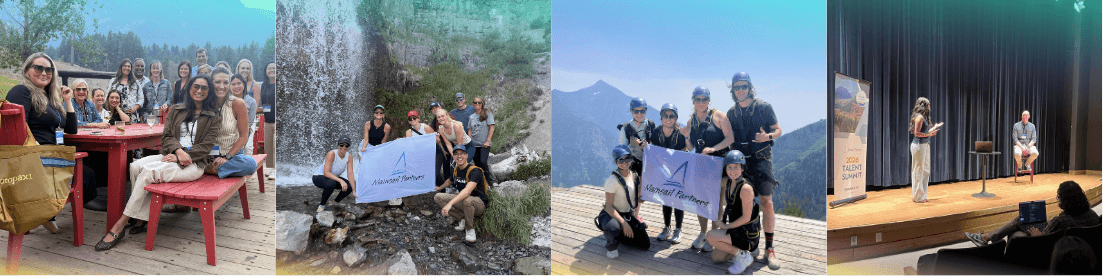
The 2026 Mainsail Talent Summit brought together people leaders from across the portfolio for candid conversations on what defines great leaders today, how software companies are putting AI to work in practice, and how people teams can build their own AI workflows right now, no engineering bottleneck involved. Every conversation was grounded in experience from operators navigating the same challenges. In between sessions, the group took a breath at Sundance: hiking the trails, tooling leather journals, riding horses, and ziplining.
What Makes a High-Performing Leader
The fundamentals of great leadership haven’t changed. Jeff Gardner, former CEO of Zen Planner and today an Executive Chair for several Mainsail portfolio companies, led a discussion on the traits of great entrepreneurial leaders and the team dynamics that define high-growth companies.
- Trust is the foundation of everything. The best leaders take responsibility when things go sideways, advocate fiercely for their people, and challenge them privately, not publicly.
- Know your team like chess pieces. Every person has moves where they’re exceptional and moves where they’ll struggle. The best leaders deploy people where they are strongest.
- Knowing your people personally – their ambitions, blind spots, what matters to them – makes the hard conversations land with care, and the good people stay.
- Celebrate wins deliberately. The leaders most likely to skip celebrating may not need it, but a lot of their people do.
- Great leadership is adaptive. What someone needs early in their career is different from what they need later. The best leaders know the difference and adjust accordingly.
- The most sincere form of development is honest feedback delivered with care. Great leaders highlight blind spots directly and give people grace as they work through them.
People, Culture & Accountability
Ben Hodson, CEO of JobNimbus, shared what he’s learned by leading people through uncertainty around AI and building a culture where adoption can take hold.
- Leadership drives the belief that AI matters. It is unlike any tool that has come before, and nobody is an expert. But the window of time to focus is now and the advantage goes to whoever learns fastest.
- The companies that get AI right are the ones that bring their people with them. People leaders are culture owners and strategic partners to their CEOs through this transition.
- In times of change, people retreat to what they know; it’s much harder to ask what could be when the answers haven’t been written yet. Leaders willing to sit in uncertainty and work through it are the ones who successfully drive change.
Building Practical AI Workflows for Your Team
Nick Olsen, Head of AI Innovation and Mainsail AI Labs led a working session on how people leaders can build and scale AI workflows on their own. During the hackathon, attendees built several working AI agents. One Chief People Officer built an agent that generates a custom “AI Assignment” for each open role to evaluate how candidates actually use AI in their work. Another built an agent that automates KPI tracking and deck creation for weekly leadership and all-hands meetings, eliminating a recurring manual task.A third built a HubSpot workflow that syncs with customer call transcripts to identify where their experience in culture or hiring could support a sale.
In addition to their builds, attendees walked away with this guidance for AI enablement on their teams:
- The person closest to the problem is the best builder. AI has removed the engineering bottleneck. HR and people leaders can now describe a workflow in plain English, build it, and refine it in real time.
- Chat to think, Cowork to do. Use chat for brainstorming. Use Cowork for producing and editing actual files. It enables inline editing, ties to your folders, and is significantly more reliable for real deliverables.
- Skills are how you scale and share your workflows. A skill is a portable, plain-English instruction file that can be shared across your team and used across tools. Start with a writing-voice skill for your most common communications.
- Slow down to speed up. The teams that move fastest with AI take protected, uninterrupted time to learn and build. Give your team this space.
- The model race is largely over for most use cases. What matters now is the harness and the skills, connectors, and structure built around the model. That’s where to invest.
- Connector permissions inherit your existing user access. Connecting Claude to your tools doesn’t create new data exposure. Loop in your IT team, but the risk is lower than it appears.
Every Talent Summit we host at Mainsail brings together thoughtful conversations about leadership, hiring, and building great companies. This year, those conversations felt especially connected. The ideas shared throughout the day highlighted the ways people strategy and technology are becoming increasingly intertwined, giving leaders new opportunities to rethink how their organizations grow.